




You finish lunch at your desk, and before the container hits the trash you’re already wondering what’s for dinner. Learning how to deal with food noise starts with one fact: this isn’t a willpower problem. Regular meals, better sleep and fewer food cues can turn the volume down. For many people with higher-weight people, GLP-1 medications quiet it even further.
I hear some version of this on video visits at Everest eClinic almost every week. A patient will say, a little embarrassed, “I know I’m not hungry. I just can’t stop thinking about food.”
You are not weak. You are not lazy. And you’re far from alone.
What Is Food Noise?
Food noise is a steady stream of unwanted thoughts about food that shows up even when you aren’t physically hungry. It isn’t the normal growl before lunch. It’s planning your next snack while you’re still eating, losing focus at work because of what’s in the fridge, or lying awake thinking about chips.
People describe it in different ways:
- “Can’t stop thinking about food.”
- “Even after I eat, I’m already planning what I’ll eat next.”
- “I feel like food controls me, not the other way around.”
- “I know I’m not hungry, but I can’t stop wanting to eat.”
That background hum takes up real mental energy. So it’s no surprise that it makes almost any eating plan feel impossible to stick with.

Why Do I Have Food Noise?
You have food noise because the brain systems that control appetite and reward may be sending stronger signals than your body needs. In many people with higher-weight people, hunger signals run louder, fullness signals run quieter, and food feels more rewarding. Genetics, environment, and the metabolic changes of excess weight all play a part.
In other words, it’s biology. It isn’t a character flaw.
Daily life can make it louder, too. Skipping meals, short sleep, stress, and a pantry full of ultra-processed snacks all feed the noise. The Cleveland Clinic also points to hunger hormones and food cues around you as common triggers.
How Do You Deal With Food Noise Day to Day?
To deal with food noise day to day, start with the basics that calm your appetite signals. Eat on a regular schedule, build meals around protein and fiber, protect your sleep and keep tempting foods out of sight. These steps won’t silence food noise for everyone, but they often take the edge off.
Here’s where I usually start with patients:
- Eat on a schedule. Long gaps make the noise louder. Three meals and a planned snack beat grazing all afternoon.
- Lead with protein and fiber. Eggs, Greek yogurt, beans, chicken and vegetables keep you full longer than a granola bar.
- Protect your sleep. After a bad night, most people notice cravings climb by mid-afternoon.
- Move food cues out of view. If the cookies sit on the counter, your brain will keep “seeing” them. Put them in a cupboard, or don’t buy them.
- Notice when it’s loud. Jot down the time and what was going on. For many people it’s 9 p.m. on the couch, not mealtimes.
- Give stress to another outlet. A short walk, a phone call, or a shower can break the loop.
If you’d like a structured plan, nutrition counseling can help you build meals that keep you full.
These habits help, but for many people with higher weight, they aren’t enough on their own. That’s not failure. It means the signal itself needs treatment.
How Do GLP-1 Medications Quiet Food Noise?
GLP-1 medications quiet food noise by acting on the brain areas that control hunger and reward. They boost fullness signals, soften the pleasure response to food, and reduce cravings. Semaglutide acts on GLP-1 receptors only, while tirzepatide acts on both GLP-1 and GIP receptors.
Here’s what that looks like in practice:
- They calm the appetite center. GLP-1 receptors sit in the hypothalamus, the part of the brain that manages hunger. Activating them reduces hunger and helps you feel satisfied with less food.
- They turn down the reward response. GLP-1 receptors are also found in the mesolimbic dopamine pathway, the brain’s reward circuit. So food still tastes good, but it stops feeling urgent.
- Reduce cravings. Clinical trials show fewer cravings and less difficulty controlling eating, which I’ll cover below.
At Everest eClinic, we prescribe semaglutide and Mounjaro (tirzepatide) as part of medical weight loss treatment, not as a standalone fix.
What Does the Research Say About Food Noise and Semaglutide?
The best data so far comes from the INFORM survey, published in Advances in Therapy in 2026. It asked 550 US adults taking semaglutide for weight management to rate their food noise before and after starting treatment, using the validated Food Noise Questionnaire.
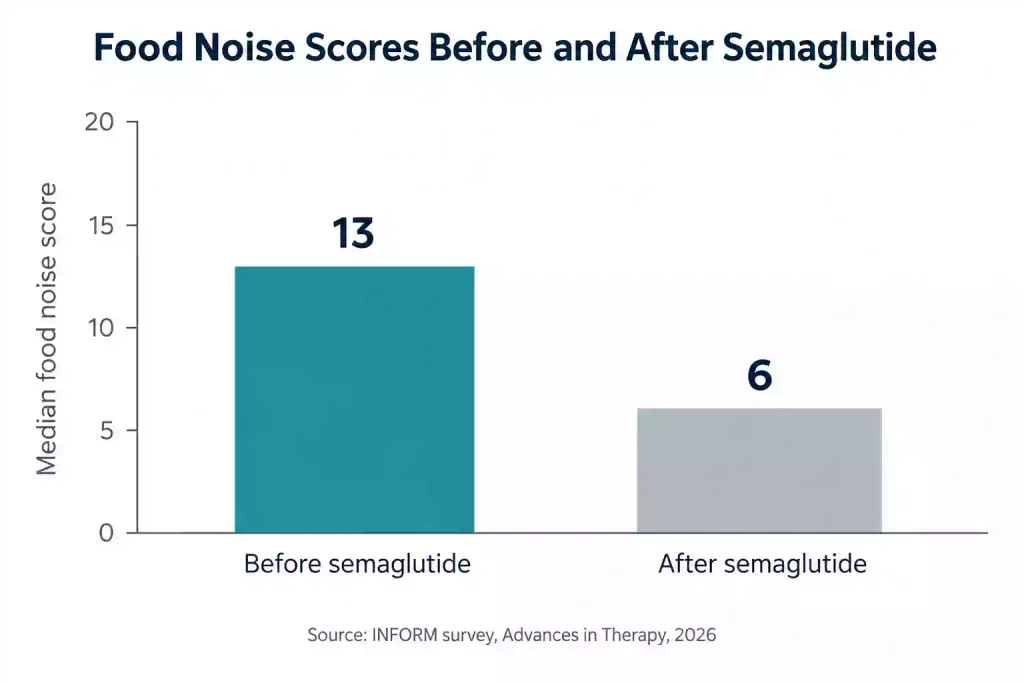
| What was measured | Before semaglutide | After semaglutide |
| Median food noise score (out of 20) | 13 | 6 |
| Agreed with statements describing food noise | 47% to 63% | 15% to 20% |
Results held steady across BMI groups and treatment length. Most respondents (83%) were satisfied with treatment, and most said their mental health, self-confidence, and habits had improved.
That said, this was a survey. People recalled their “before” scores from memory, and the results were presented by Novo Nordisk, which makes Wegovy. The authors themselves call for longer prospective studies.
Controlled trial data backs up the trend. In the two-year STEP 5 trial, people on semaglutide 2.4 mg found it easier to resist cravings and control their eating than those on placebo. Savory cravings stayed lower for two years. Sweet cravings improved at 20 and 52 weeks, though not significantly at 104.
For tirzepatide, food noise research is newer. Early brain studies are promising, but they involve very few people.
Why Quieter Food Thoughts Can Matter More Than the Scale
For many of my patients, quiet is the part that changes their life most. Weight loss matters, but so does getting your head back.
When you aren’t fighting food thoughts all day, you can focus on work, your kids, a hobby. You can go to a restaurant without anxiety. Snacks can sit in the cupboard, untouched. And after a meal, you simply move on with your day.
This isn’t about restriction. It’s about freedom.
These medications don’t make food taste bad. They help bring appetite signals back to a more normal level, so you can have a healthier relationship with food, maybe for the first time.
When Should You Talk to a Clinician About Food Noise?

You should talk to a clinician about food noise when it affects your work, sleep, mood, or relationships, or when months of steady habits haven’t helped. Get help sooner if food thoughts come with wallowing, purging, or severe restriction. Those can be signs of an eating disorder that needs specialized care.
One honest note: GLP-1 medications are not FDA-approved to treat food noise by themselves. They’re prescribed for weight management or type 2 diabetes when you meet the medical criteria. A provider can check whether you qualify and whether it’s safe for you.
Frequently Asked Questions About Food Noise
For broader questions about our services and approach, visit our FAQ page.
You Don’t Have to Fight Your Brain Every Day
If you’re constantly thinking about food and it’s wearing you down, you are not failing. Your appetite system is working against you. Figuring out how to deal with food noise usually starts with steady daily habits. For the right person, a GLP-1 medication can quiet the cravings and give you back the mental space to live your life.
There is help, and it works.
Contact Everest eClinic to speak with a provider about your options.
Sincerely,
Geeta Sharma,
DNP Endocrinology Nurse Practitioner
Everest Diabetes & Weight Loss
Connecticut: 203-689-0558 Office Phone or Text
Texas: Call: 512-541-2126

This article is for informational purposes and does not replace individualized medical advice. Talk to your provider before starting or stopping any medication.