




If you’re going through perimenopause or menopause and feel like your body has changed almost overnight, you’re not imagining it. The weight gain, the belly fat, the cravings, the fatigue, the brain fog: these are real, and they’re connected to the hormonal shifts happening inside your body right now.
And if it feels like nothing works anymore, no matter how well you eat or how often you exercise, there’s a biological reason for that. Understanding what’s changed is the first step toward doing something about it.
What Happens to Your Body During Menopause
Estrogen isn’t just a reproductive hormone. It also plays a major role in metabolism, body composition, and cardiovascular health. As levels decline through perimenopause and menopause, several things shift at once.
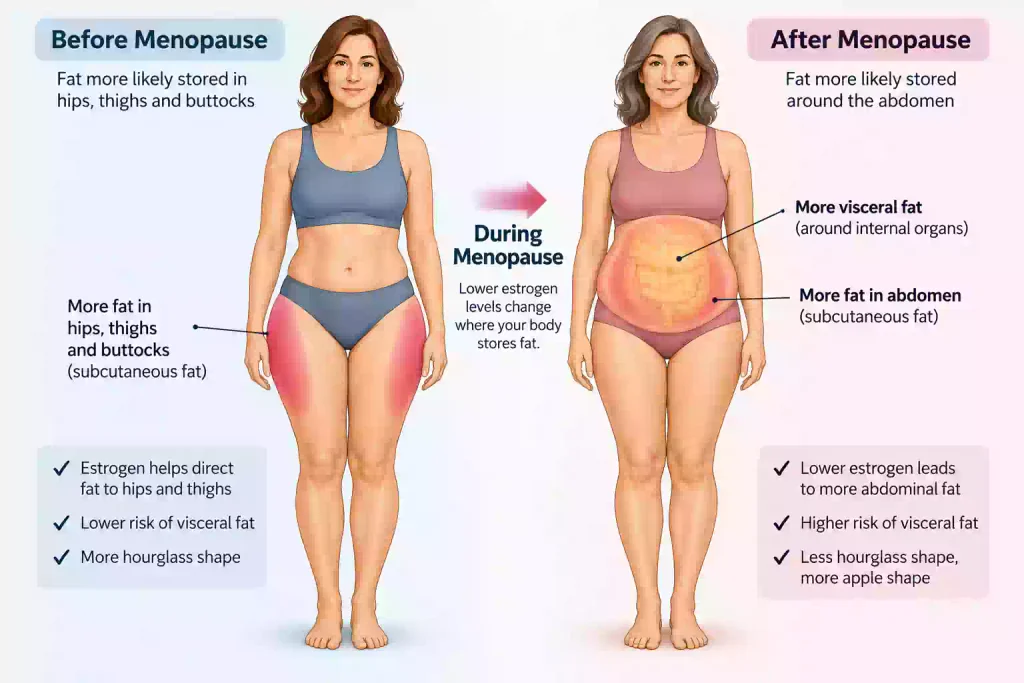
Fat moves to your midsection.
Before menopause, women tend to store fat in the hips and thighs. After menopause, fat shifts toward the abdomen instead, in the form of visceral fat, the kind that wraps around your organs, produces inflammatory compounds, and drives insulin resistance.
Your metabolism slows.
Estrogen helps regulate how many calories your body burns at rest. One study measuring resting metabolic rate found it ran about 10 percent lower in sedentary postmenopausal women compared with premenopausal women of similar age, though that gap disappeared among women who exercised regularly.
Insulin resistance increases.
Estrogen helps your cells respond to insulin. As it declines, your body needs to produce more insulin to manage the same amount of blood sugar, and higher insulin levels encourage your body to store fat rather than burn it.
Cravings and appetite change.
Hormonal fluctuations affect the brain’s hunger and reward centers, which is part of why so many women notice stronger cravings, especially for carbohydrates and sweets, during this transition.
Cholesterol and triglycerides rise.
Estrogen helps keep LDL (“bad”) cholesterol down and HDL (“good”) cholesterol up. After menopause, LDL tends to rise, HDL tends to fall, and triglycerides climb, all of which raise cardiovascular risk at a life stage when that risk already matters more.
Inflammation increases.
Estrogen has anti-inflammatory effects. Without it, systemic inflammation tends to rise, which can show up as joint pain, fatigue, and a general sense of aging faster than expected.
Why Diet and Exercise Alone Often Aren’t Enough
Slower metabolism, rising insulin resistance, stronger cravings, and a shift toward visceral fat storage add up to a combination that makes calorie restriction alone a poor match for what’s happening in a menopausal body. This isn’t a willpower problem. It’s a biology problem, and it often calls for a different kind of tool.
This is where GLP-1/GIP medications can help.
How GLP-1/GIP Medications Help During Menopause
They quiet cravings and appetite.
GLP-1 receptor agonists act on the brain’s hunger centers to reduce appetite and quiet the constant “food noise” that many women describe during menopause. Clinical trial data shows these medications reduce cravings for both sweet and savory foods.
They target visceral fat specifically.
In clinical trials, GLP-1/GIP medications have produced total body weight loss in the range of 15 to 21 percent, with a disproportionate share of that loss coming from visceral fat, the exact type that accumulates after menopause and drives metabolic disease.
They improve insulin sensitivity.
By helping the body respond better to insulin, these medications can interrupt the cycle where insulin resistance drives fat storage, which then worsens insulin resistance further.
They support heart health.
As estrogen’s protective effects on cholesterol and blood vessels fade, GLP-1/GIP medications can help fill that gap. Trials show meaningful drops in LDL cholesterol and triglycerides, along with systolic blood pressure reductions of roughly 3 to 8 mm Hg, and in some cases, measurable cholesterol improvements too.
They lower inflammation.
In large placebo-controlled trials, semaglutide reduced CRP (a key inflammation marker) by roughly 39 to 49 percent, and tirzepatide has shown reductions in a similar range in cardiovascular outcome trials. Lower inflammation may help explain why some women report less joint pain and fatigue once treatment starts.
Does Menopause Change How Well These Medications Work?
This is a genuinely active area of research, and it’s worth being upfront about what’s known and what isn’t.
A secondary analysis of the SURMOUNT tirzepatide trials, led by researchers at NewYork-Presbyterian and Weill Cornell Medicine, found that tirzepatide produced comparable reductions in body weight and waist circumference across premenopausal, perimenopausal, and postmenopausal women. That’s reassuring on its own, but a separate Mayo Clinic cohort study looking specifically at hormone therapy added an important layer of nuance: postmenopausal women not using hormone therapy lost close to 15 percent of their body weight on tirzepatide over 18 months, while postmenopausal women who were also using hormone therapy lost closer to 20 percent, putting them in line with pre- and perimenopausal women.
In other words, estrogen may not block a GLP-1 medication from working, but adding hormone therapy back into the picture may help some postmenopausal women get more out of treatment. Researchers are clear that this needs more study before it changes clinical guidance, but it’s a promising direction.
Does GLP-1 Cause Bone Loss During Menopause?
Weight loss at any age can affect bone density, and that’s worth taking seriously during menopause, when declining estrogen already accelerates bone loss on its own. Endocrinology researchers have flagged this combination as something women using GLP-1 medications in midlife should discuss with their provider, alongside strategies like resistance training and adequate protein intake to help protect muscle and bone while losing fat.
Can You Combine GLP-1 Medications With Hormone Replacement Therapy?
Many women going through menopause are already using HRT, whether that’s an estrogen patch, progesterone, or a combination. The good news is that GLP-1/GIP medications can typically be used alongside HRT, and, as the research above suggests, the two may work well together. HRT addresses the hormone deficiency directly, while a GLP-1 medication addresses the metabolic consequences, weight gain, insulin resistance, inflammation, and cholesterol changes, that HRT alone doesn’t fully resolve.
If you’re already on HRT and still struggling with your weight, it’s worth asking your provider whether adding a GLP-1 medication makes sense for you. One Everest eClinic patient described exactly this pattern: months of eating well and exercising daily with the scale barely moving after entering menopause, followed by steady, gradual weight loss once she started semaglutide under her provider’s guidance.
Key Takeaways
- Declining estrogen changes where you store fat, how fast you burn calories, and how your body handles insulin and cholesterol.
- Diets often stop working during menopause because the underlying biology has shifted, not because of a lack of effort.
- GLP-1/GIP medications directly address several of these shifts: appetite, visceral fat, insulin sensitivity, cholesterol, and inflammation.
- Current research suggests these medications remain effective across reproductive stages, and combining them with hormone therapy may boost results further for some postmenopausal women.
- Bone health is worth monitoring during any significant weight loss in midlife, GLP-1 treatment included.
Frequently Asked Questions
Should You Try a GLP-1 Medication for Menopause Weight Gain?

For most women whose weight gain, cravings, and cholesterol shifted after perimenopause or menopause set in, a GLP-1 medication is worth discussing with a provider, especially once diet and exercise alone have stopped moving the needle. Menopause changes how your body stores fat, processes sugar, manages cholesterol, and handles inflammation, and GLP-1/GIP medications are built to address exactly those shifts.
They aren’t a treatment for menopause itself, and they work best alongside the fundamentals: enough protein, some resistance training, and, for many women, hormone therapy. But for the metabolic side of menopause, they’re one of the most effective tools available right now.
If you want to know whether a GLP-1 medication fits your stage of menopause, Geeta Sharma, DNP, NP-C at Everest eClinic can walk you through the options as part of a personalized, telehealth weight loss plan. Book a visit to get started.
Contact Everest eClinic to speak with a provider about your options.
Sincerely,
Geeta Sharma,
DNP Endocrinology Nurse Practitioner
Everest Diabetes & Weight Loss
Connecticut: 203-689-0558 Office Phone or Text
Texas: Call: 512-541-2126

This article is for informational purposes and does not replace individualized medical advice. Talk to your provider before starting or stopping any medication.