



When most people think about cholesterol, they think about statins. And statins are excellent medications; they remain the cornerstone of cholesterol management. But what if there was a medication that could improve your cholesterol, help you lose weight, lower your blood pressure, reduce inflammation, and protect your heart all at the same time?
That class of medications exists. They are GLP-1/GIP medications.
Is GLP-1 Worth Adding to Your Statin?
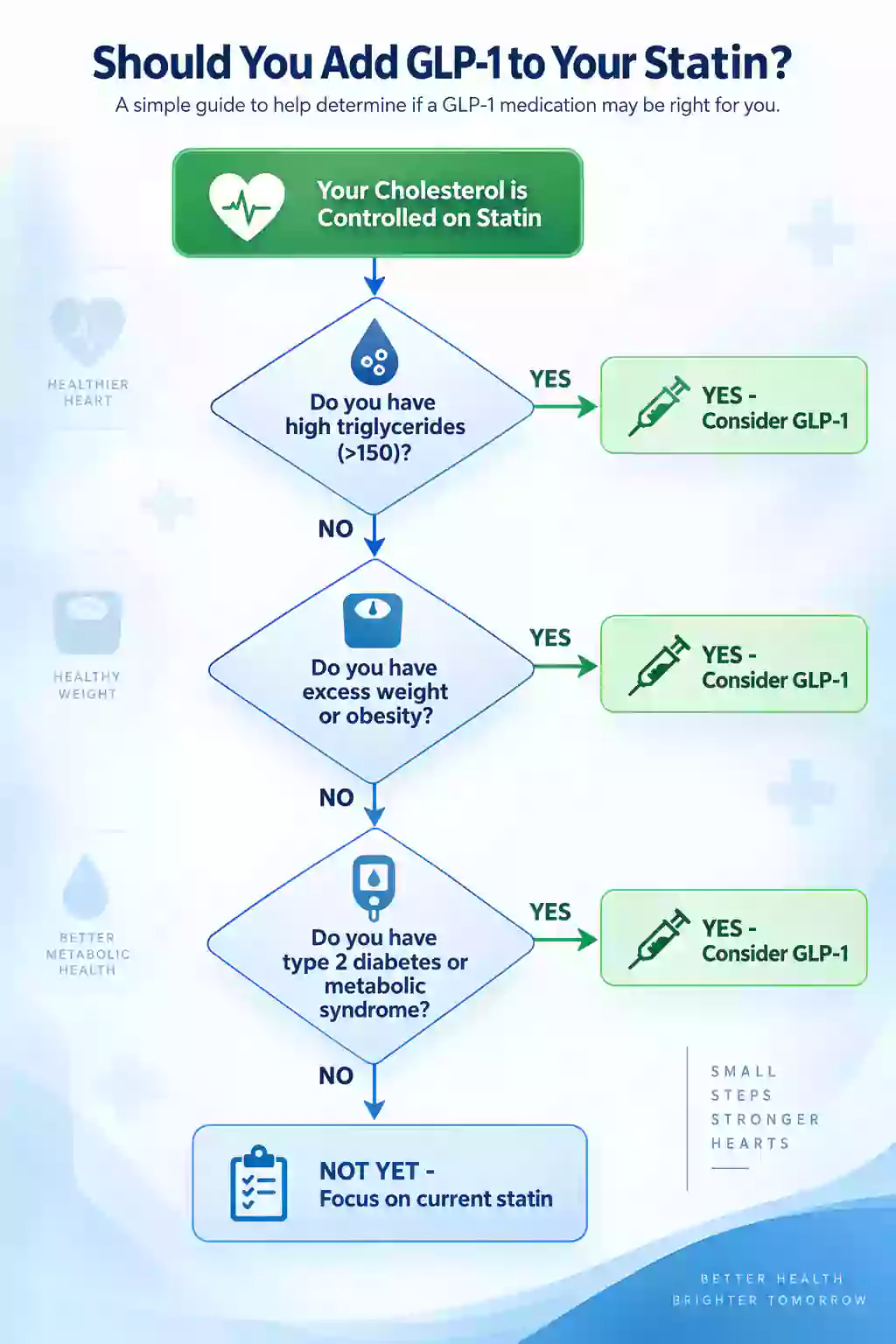
Before diving into the science, here’s the practical question most patients ask: “My doctor has me on a statin. Does adding a GLP-1 make sense if my cholesterol is already controlled?”
Consider adding GLP-1 if you have:
- High triglycerides (>150 mg/dL) that persist despite statin therapy
- Low HDL cholesterol (<40 mg/dL) with excess weight
- Type 2 diabetes or metabolic syndrome
- Obesity or excess weight plus any cholesterol abnormality
- Established cardiovascular disease with excess weight
GLP-1 is less compelling if: Your weight is stable, your cholesterol is at goal on a statin, and you have no met
What the Evidence Shows
GLP-1/GIP medications have been shown to improve cholesterol across dozens of clinical trials.
Semaglutide (STEP 1 trial):
Semaglutide 2.4 mg reduced total cholesterol by approximately 6–7 mg/dL, LDL cholesterol by 3–6 mg/dL, triglycerides by 7–15 mg/dL, and increased HDL slightly. More importantly, when researchers compared participants who lost the same amount of weight on semaglutide versus placebo, those on the GLP-1 medication still had greater cholesterol improvements. This tells us the drug itself is working beyond weight loss alone.
Semaglutide (SOUL trial):
Total cholesterol, non-HDL cholesterol, and triglycerides all decreased within 13 weeks and remained improved for up to 4 years.
Tirzepatide (SURPASS-2 trial):
Tirzepatide produced greater triglyceride and VLDL reductions than semaglutide, likely due to dual GLP-1/GIP receptor activation. It also produced greater increases in HDL cholesterol.
Meta-analysis (35 GLP-1 trials):
Confirmed modest but consistent reductions in total cholesterol, LDL cholesterol, and triglycerides across the entire GLP-1 drug class.
| Lipid Marker | Typical Change | Notes |
| LDL cholesterol | Down 3–6 mg/dL | Modest; statin reduces by 50%+ |
| Triglycerides | Down 7–15 mg/dL (up to 40% if elevated) | Standout benefit |
| Total cholesterol | Down 6–7 mg/dL | Modest benefit |
| HDL cholesterol | Up 1–2 mg/dL | Small but consistent |
How Do GLP-1/GIP Medications Improve Cholesterol?
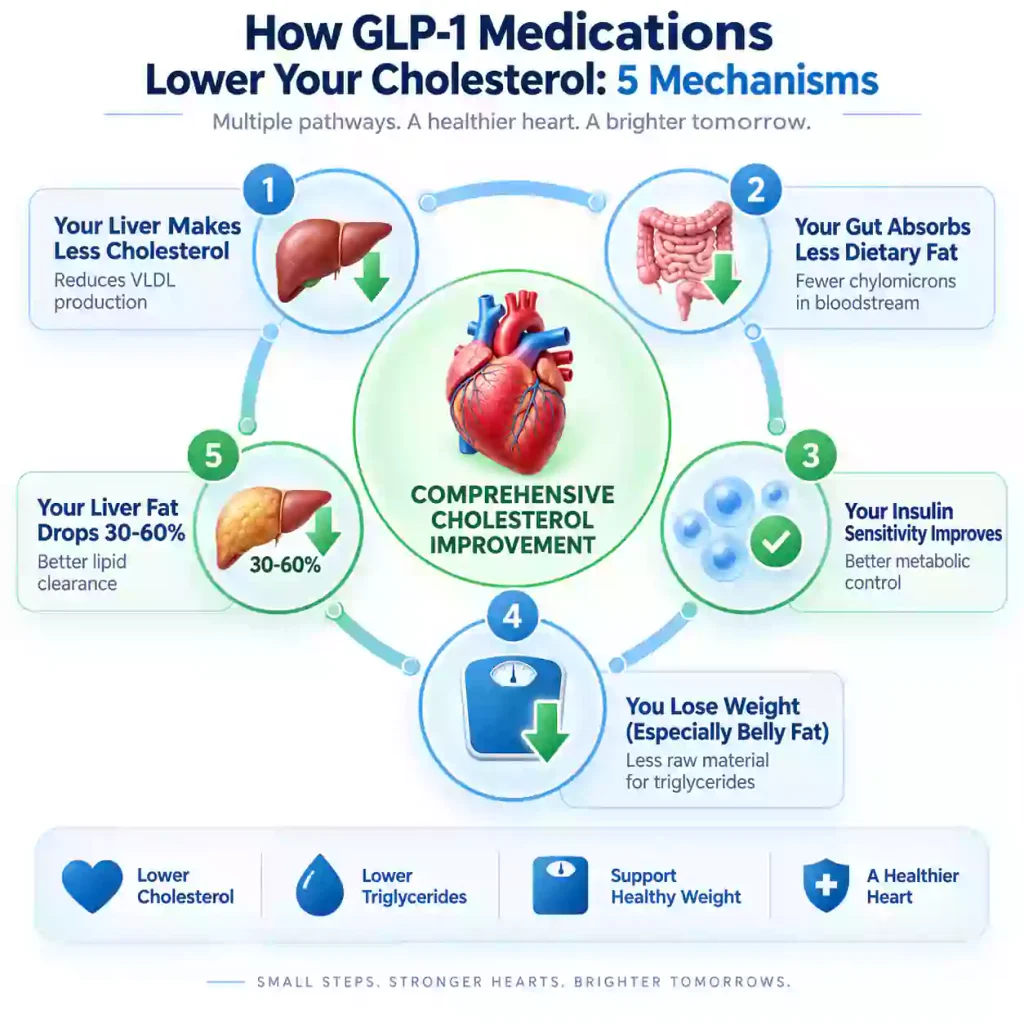
The mechanisms are multifaceted.
Reduced postprandial lipid absorption
GLP-1/GIP medications reduce chylomicron production—the particles that carry dietary fat from your intestines into your bloodstream after meals. Less dietary fat in circulation means lower triglycerides and VLDL.
Improved insulin sensitivity
Insulin resistance drives the liver to produce more VLDL particles and creates small, dense LDL particles that damage arteries. When GLP-1/GIP medications improve insulin sensitivity, this pattern normalizes.
Weight loss
Excess body fat is a major driver of dyslipidemia. Your liver uses free fatty acids to manufacture triglycerides. Less excess fat means less raw material.
Reduced hepatic fat
GLP-1/GIP medications reduce liver fat by 30–60%, improving the liver’s ability to process and clear lipids from the bloodstream.
Reduced inflammation
GLP-1/GIP medications reduce CRP (C-reactive protein) and other inflammatory markers by 39–57%. As covered in our article on how semaglutide helps fight inflammation, this reduces the atherogenic potential of LDL particles, making them less likely to embed in artery walls even before their numbers drop.
Important Context: GLP-1/GIP Medications Are Not Statin Replacements
While the cholesterol improvements with GLP-1/GIP medications are real and clinically meaningful, they are modest compared to statins. A high-intensity statin like atorvastatin 80 mg can reduce LDL by 50% or more. GLP-1/GIP medications typically reduce LDL by 3–6 mg/dL—a much smaller effect.
The value is different. GLP-1/GIP medications address metabolic drivers that statins do not: weight, insulin resistance, inflammation, postprandial lipids, and liver fat. For patients already on a statin with elevated triglycerides, low HDL, excess weight, or residual cardiovascular risk, GLP-1/GIP medications tackle those issues.
The combination approach is powerful. Statin therapy handles LDL reduction. GLP-1 therapy handles weight loss, triglyceride reduction, inflammation reduction, blood pressure lowering, and liver fat reduction. Combined, they provide more comprehensive cardiovascular protection than either medication alone.
What This Means If You Are Already on a Statin
If you start a GLP-1/GIP medication while taking a statin, your lipid numbers may drop further. In the STEP 1 trial, 20% of semaglutide-treated participants who had hypertension at baseline were able to stop at least one blood pressure medication entirely. Some patients do eventually reduce statin doses as their cholesterol improves and cardiovascular risk drops, but this requires medical supervision.
Bring your lipid results to your provider at your next visit. Have an explicit conversation about whether adjustments to your medications make sense based on your individual cardiovascular risk profile.
What GLP-1s Really Do for Your Heart
GLP-1/GIP medications improve your cholesterol by lowering LDL, reducing triglycerides, lowering total cholesterol, and sometimes raising HDL. These improvements come from weight loss, improved insulin sensitivity, reduced liver fat, reduced inflammation, and direct effects on lipid metabolism.
Combined with their effects on blood pressure, inflammation, and blood sugar, GLP-1/GIP medications provide comprehensive cardiovascular risk reduction that goes far beyond what any single cholesterol medication can offer.
If you have high cholesterol along with obesity, diabetes, or metabolic syndrome, a GLP-1/GIP medication may be protecting your heart in ways you do not realize.
Frequently Asked Questions
Are GLP-1s Right for Your Heart Health?
GLP-1/GIP medications improve cholesterol—but they’re not cholesterol specialists. Statins excel at lowering LDL. GLP-1 medications handle what your statin cannot: weight loss, triglyceride reduction, inflammation reduction, blood pressure lowering, and liver fat improvement.
Start GLP-1 if you have:
- High triglycerides despite statin therapy
- Excess weight plus metabolic syndrome
- Type 2 diabetes or prediabetes with abnormal cholesterol
- Cardiovascular disease with obesity
Don’t start GLP-1 solely for cholesterol if:
- Your weight is stable, and cholesterol is at goal on a statin with no other metabolic issues
The real message: Don’t start GLP-1 just to lower LDL cholesterol. Start it for weight loss, metabolic health, and comprehensive cardiovascular protection. The cholesterol improvement is a valuable side benefit, not the main reason.
At Everest eClinic, our Board Certified Nurse Practitioner helps patients on medical weight loss therapy understand whether GLP-1 complements their statin and addresses the metabolic root causes of their cardiovascular risk. If you’re already on a statin and wondering whether adding a GLP-1 makes sense for your specific situation, we’re here to help you decide.
Contact Everest eClinic to speak with a provider about your options.
Sincerely,
Geeta Sharma,
DNP Endocrinology Nurse Practitioner
Everest Diabetes & Weight Loss
Connecticut: 203-689-0558 Office Phone or Text
Texas: Call: 512-541-2126

This article is for informational purposes and does not replace individualized medical advice. Talk to your provider before starting or stopping any medication.